
“`html
Many factories measure Overall Equipment Effectiveness (OEE) to assess how efficiently their operations run, but few take actionable steps based on the data. The main reason is a lack of real-time data integration, which leads to delays in decision-making. Understanding and acting on OEE insights can significantly enhance productivity and reduce costs. This article explores the intricacies of OEE and how factories can leverage it effectively.
What is OEE and why do factories measure it?
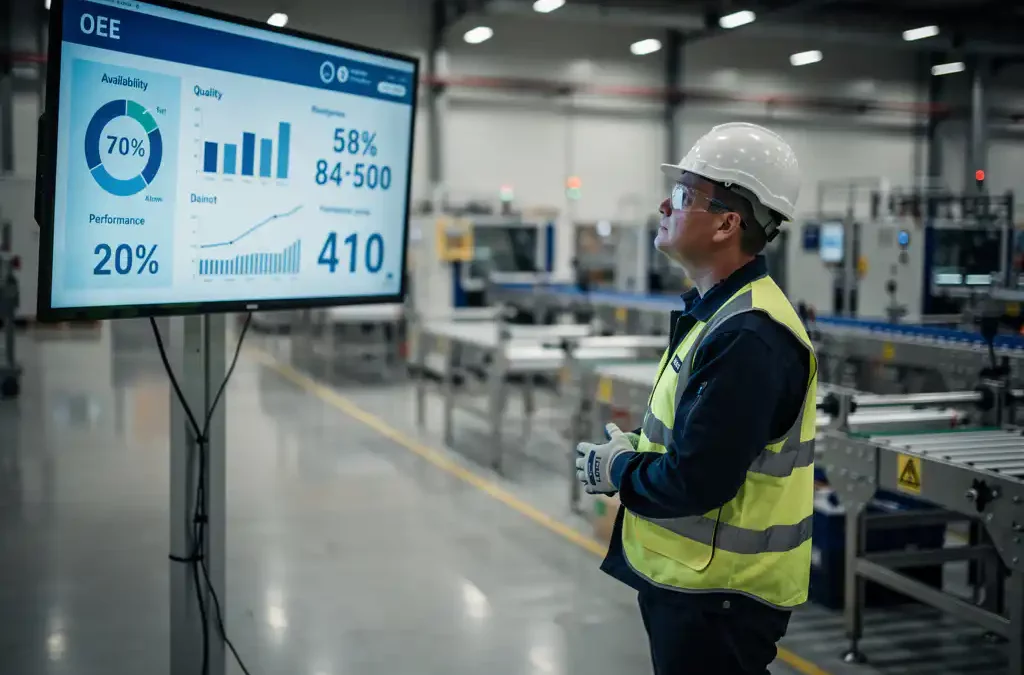
OEE, or Overall Equipment Effectiveness, is a metric used to evaluate the efficiency and productivity of manufacturing processes. It combines three key factors: availability, performance, and quality, to provide a comprehensive view of how well a manufacturing operation is functioning. Factories measure OEE to identify areas for improvement and optimize production processes.
By measuring OEE, factories can pinpoint inefficiencies such as machine downtime, slow production rates, and quality defects. This insight helps them make informed decisions to enhance operational efficiency. OEE serves as a benchmark for comparing performance over time or against industry standards, highlighting potential areas for improvement.
How is OEE calculated in manufacturing?
OEE is calculated by multiplying three components: availability, performance, and quality. Availability measures the percentage of scheduled time that the equipment is available to operate. Performance assesses whether the equipment is running at its maximum speed. Quality evaluates the proportion of good units produced versus total units started.
To calculate OEE, use the formula: OEE = (Availability × Performance × Quality) × 100%. Each component is expressed as a percentage, and the final OEE score indicates the overall efficiency of the equipment. For instance, a machine with 90% availability, 95% performance, and 98% quality would have an OEE of 83.79%.
Why do factories struggle to act on OEE data?
Factories often struggle to act on OEE data due to a lack of real-time information and integration between IT and OT systems. This disconnect leads to delays in data updates and decision-making. Additionally, the absence of a structured follow-up system for addressing identified issues further hampers action.
Many factories rely on manual data collection and reporting, which can be time-consuming and prone to errors. Without automated systems that provide real-time insights, factories miss opportunities to address inefficiencies promptly. Furthermore, a lack of ownership and accountability in following up on action items can result in unresolved issues.
What are the benefits of acting on OEE insights?
Acting on OEE insights can lead to significant improvements in productivity, cost savings, and operational efficiency. Manufacturers have reported typical results such as a 5-8 point improvement in OEE within 6-12 months of implementing real-time OEE visibility.
By addressing inefficiencies highlighted by OEE data, factories can reduce downtime, optimize production schedules, and improve product quality. This proactive approach not only enhances overall performance but also increases competitiveness in the market. Additionally, it fosters a culture of continuous improvement and data-driven decision-making.
How can factories improve their OEE action plans?
Factories can improve their OEE action plans by implementing real-time data integration, assigning clear ownership for action items, and utilizing structured frameworks for continuous improvement. Leveraging technology to automate data collection and analysis is crucial.
Adopting a digital shopfloor platform like Factorise can facilitate these improvements by providing a unified data model and real-time insights. This enables factories to identify and address inefficiencies promptly. Additionally, establishing a culture of accountability and regular follow-up on action items ensures that improvements are sustained over time.
What role does technology play in enhancing OEE utilization?
Technology plays a pivotal role in enhancing OEE utilization by providing real-time data, automating processes, and facilitating seamless integration between IT and OT systems. It enables factories to monitor equipment performance continuously and make informed decisions based on accurate data.
Implementing advanced technologies such as IoT sensors and digital platforms helps capture real-time data from the shopfloor. This data can be analyzed to identify patterns and predict potential issues before they occur. By bridging the IT/OT gap, technology ensures that all stakeholders have access to the same accurate information, enabling coordinated efforts to improve OEE.
Factorise’s digital shopfloor platform offers a comprehensive solution for manufacturers looking to enhance their OEE utilization. Ready to take the first step? We like to start with a fit-gap session: a day or two to understand where you are, which pain points are most urgent, and which modules deliver the fastest value. Book your first fit-gap session. No sales pitch. Just an honest conversation about what’s realistic.
“`
Related Articles
- What are the most common causes of machine downtime in a factory?
- How do you track machine downtime in a factory?
- What is preventive maintenance in manufacturing?
- What is condition-based maintenance in manufacturing?
- How do you start measuring OEE if you have never done it before?
- Why does inconsistent OEE measurement make improvement impossible?
- What causes low OEE in a factory?
- What is the difference between OEE and TEEP?
- Why is 85% OEE considered world-class?
- Does the 85% OEE benchmark apply to every type of factory?
- What does OEE stand for?
- How is OEE calculated?
- How do you measure performance losses in OEE?
- How do you calculate availability in OEE?
- What is world-class OEE and how far is the average factory from achieving it?