Solutions.
Connected Worker
Operators with the right information. Right place. Right moment.
Connected Worker is not about tablets on the floor. It is about closing the loop between the people who do the work and the systems that run the business. Factorise gives every operator and technician the context they need to act, and feeds what they do back into the operation in real time.
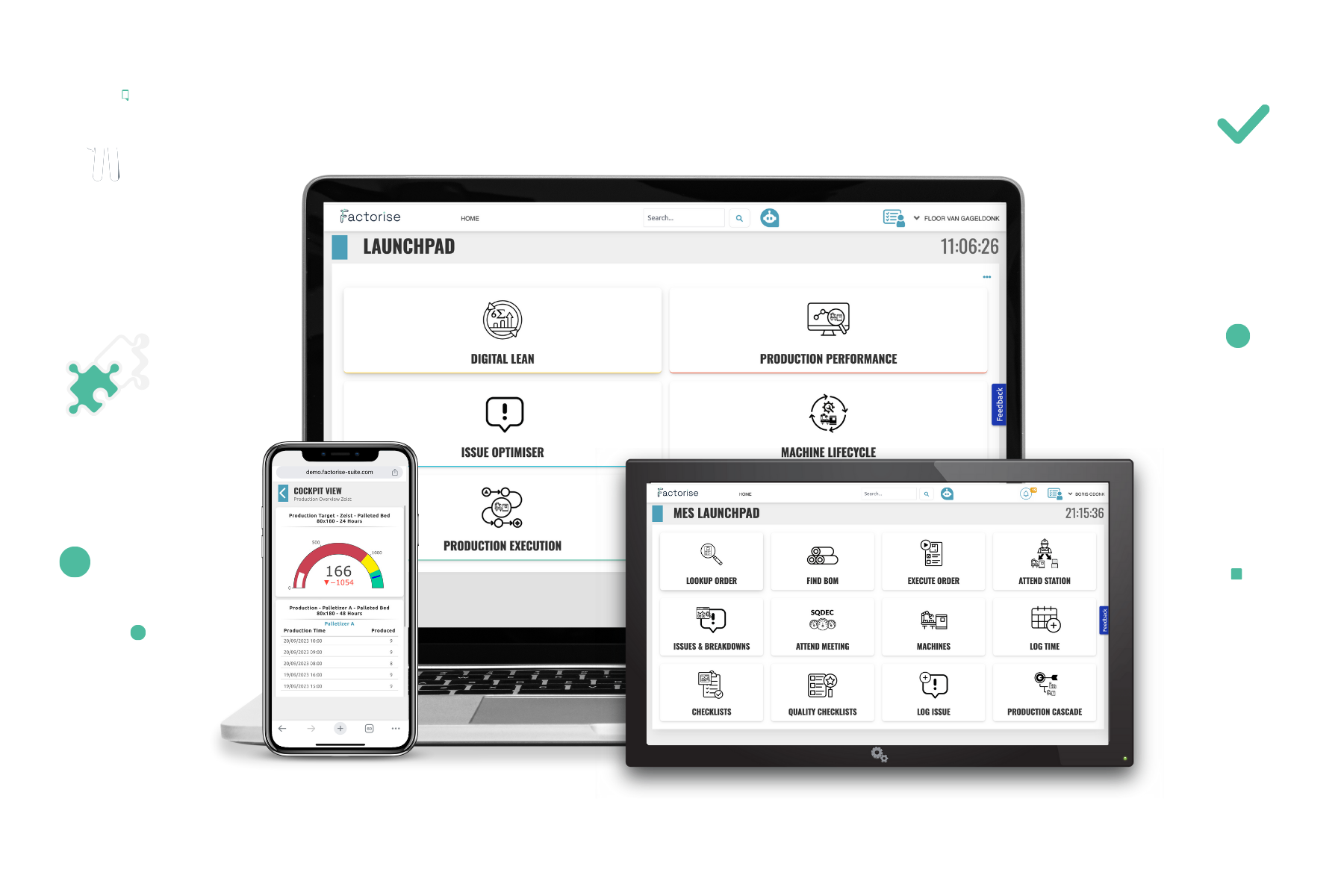
Platform for every shop floor role, on any device
Bidirectional SAP APIs running live at a global chemical customer
Connected Worker rollouts deliver value in weeks, not years
Why Connected Worker matters.
A connected worker is an operator or technician who has live access to what they need to do their job. Work instructions, machine data, asset history, quality requirements, safety procedures. Available directly at the machine, on a mobile device or workstation. No more walking back to a desk, calling a supervisor, or working from a printout that is two months out of date.
But Connected Worker is more than a digital binder. It is the link between the floor and the systems that run the business. When an operator finishes a step, the ERP knows. When a quality check fails, the right team gets notified. When a permit-to-work needs approval, it happens in the same flow as the maintenance job. The information goes both ways, and the loop is closed.
Most plants try to solve this with separate apps for separate problems. One tool for instructions, another for issues, a third for time logging, a fourth for safety. Operators end up logging into four systems to do one job. Adoption stalls, data stays scattered, and the loop never actually closes.
How factorise solves it.
Use Cases.



How factorise solves it.
Six building blocks.
Connected Worker
One Launchpad per Role
Every operator, supervisor and technician gets a single screen with exactly what they need. No menu hunting, no logging into multiple tools. The role decides the launchpad, the launchpad decides the work.
Mobile-first Execution
Tablets, scanners, phones, workstations. The same platform works on whatever device fits the job. Operators stay at the machine instead of walking back to a desk.
Live ERP Integration
Native, bidirectional connectors to SAP, Microsoft Dynamicsand others. What happens on the floor updates the ERP. What changes in the ERP shows up on the floor. No nightly batch jobs, no overnight surprises.
Built-in Quality, Safety & Compliance
Checklists, inspections, sign-offs and permits live inside the work, not next to it. The right check happens at the right step, by the right person, with a full audit trail.
Skills & Qualification Awareness
The system knows who is qualified for which task. Operators only see work they can do. Supervisors see coverage gaps before the shift starts, not after.
Two-way Issue Capture
Operators log what they see at the moment they see it, with QR scan or one tap. Issues route to the right owner, get fixed, and feed back into root cause analysis. The floor becomes the source of truth instead of a black box.
The results we have seen so far can be measured in the amount of spreadsheets we are not using anymore.
The launchpad
At the centre of it all is one screen, configured per role. An operator sees orders, instructions and quality checks. A maintenance technician sees work orders, asset 360 and shift book. A supervisor sees live OEE, manning and open issues. Same platform, same data, different views. Adding a new module means a new tile, not a new login.
Why this approach works.
Connected Worker is often sold as a frontline app. Factorise treats it as a platform: one data model, one launchpad, one environment that works for every role on the floor. Adoption follows naturally because operators are not switching between tools. They are doing their job in one place.
Built on Mendix, deployed under your own licence, in your own environment. The same platform that gives the operator their next step gives management a live picture of what is happening. No reports needed, no dashboards to maintain. The data is already there.