
Suite 01 · Production Execution
Digital control over what actually happens.
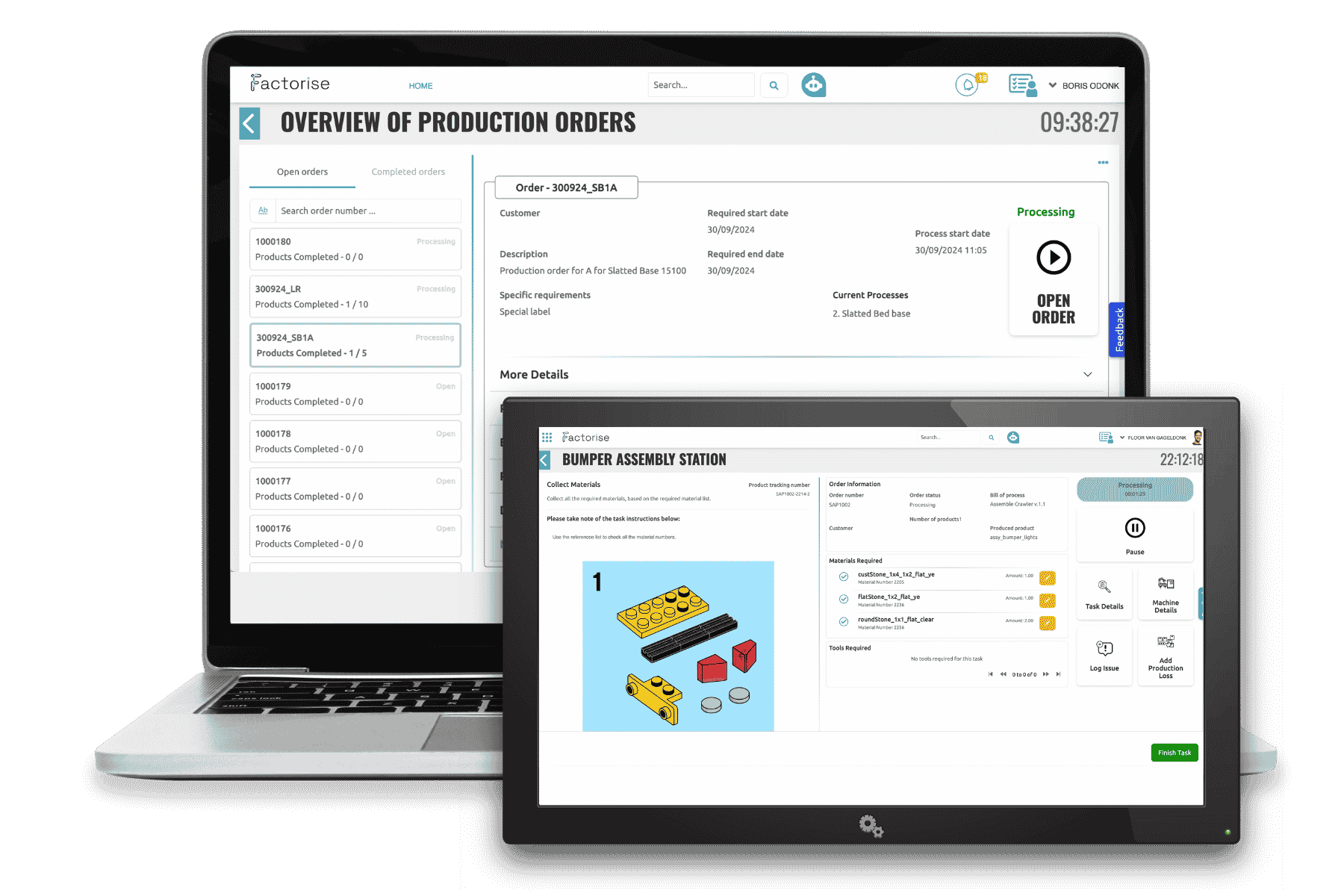
Operators work from printed instructions, orders get tracked in Excel, and nobody knows where a batch has been. Factorise replaces the paper trail with digital order execution, full traceability and real-time control — the core of your MES.
Relevant for:
Production · Quality (QESH)
28%
productivity boost
Faster, consistent changeovers across all operators and shifts.
20%
cost savings
Less waste and fewer rework cycles through digital standard work.
85%
faster shift handovers
Structured digital handovers replace 20-minute verbal walk-throughs, getting the incoming shift to full speed in under 3 minutes.
Pain points this suite solves
Sound familiar?
Operators juggle multiple systems and enter the same data more than once — manual re-entry is slow, error-prone, and nobody’s idea of value-added work.
Nobody knows where an order stands without walking the floor or calling a supervisor.
Changeovers are inconsistent — every operator does it differently, timing isn’t tracked, and OEE suffers invisibly.
All modules
14 modules.
One suite.
Shift Book
What it does: Digital handover log where outgoing and incoming shifts record what happened, what is still open, and what the next team needs to know.
Why it matters: Shifts start informed. The "nobody told me" problems go away once handovers are structured and searchable.
Order Execution
What it does: Guides operators through a production order step by step, with process instructions, material requirements, and quality checks built into the flow.
Why it matters: Consistent execution whoever is on shift. Particularly valuable in high-turnover environments.
OEE Calculator
What it does: Calculates Overall Equipment Effectiveness in real time per machine or line.
Why it matters: OEE visible during the shift, not just in the weekly report. That difference in timing changes what people do with it.
Production Orders
What it does: A live overview of all production orders with status, priority, and progress.
Why it matters: Planners and supervisors know where every order stands. Delays are visible early, not at the moment of delivery.
Open Change Overs
What it does: Tracks changeover tasks between production orders, including checklists and timing per step.
Why it matters: Changeovers that follow the same process every time, by every operator. Timing data feeds directly into OEE and improvement work.
Quality Assurance
What it does: Digital QA checklists and records linked to production steps and orders.
Why it matters: Structured, searchable quality documentation. Considerably easier to work with than paper binders during an audit.
Product Traceability
What it does: Records what materials and components went into every produced unit or batch.
Why it matters: When a quality issue surfaces, having this data turns a week-long investigation into an afternoon.
Production Loss
What it does: Logs production stoppages, speed losses, and quality losses as they happen, with cause categorisation.
Why it matters: Loss data captured at the source is worth considerably more than loss data reconstructed at the end of the week.
Production Loss Pareto
What it does: Pareto analysis of losses by category, machine, shift, and period.
Why it matters: Points improvement effort at the right targets. Most operations have two or three loss categories that account for the majority of the OEE gap.
Position Manning
What it does: Assigns operators to specific workstations per shift and shows real-time presence across the floor.
Why it matters: Supervisors see coverage gaps before the shift starts, not halfway through it.
Order Confirmations
What it does: A digital sign-off process for closing production orders, capturing quantities, quality outcomes, and operator confirmation.
Why it matters: Replaces paper forms and manual ERP entries that typically happen at the end of a run. Faster closure, cleaner records.
Inventory Management
What it does: Tracks raw materials, WIP, and finished goods by location, batch, and stock level.
Why it matters: Material traceability from receipt to shipment, and fewer production stoppages caused by stock surprises.
Scan Item QR
What it does: QR scanning for identification of items, materials, and assets at the point of use.
Why it matters: Faster and more accurate than manual entry. Operators who scan rarely make the same data entry mistakes that operators who type do.
Order Planning
What it does: An interactive planning board for sequencing orders across resources and shifts.
Why it matters: Less last-minute schedule shuffling. When capacity and demand are visible in the same place, planning gets more realistic.
See it running in your environment
We’ll show you the Production Execution Suite against your processes, not a generic demo script.