
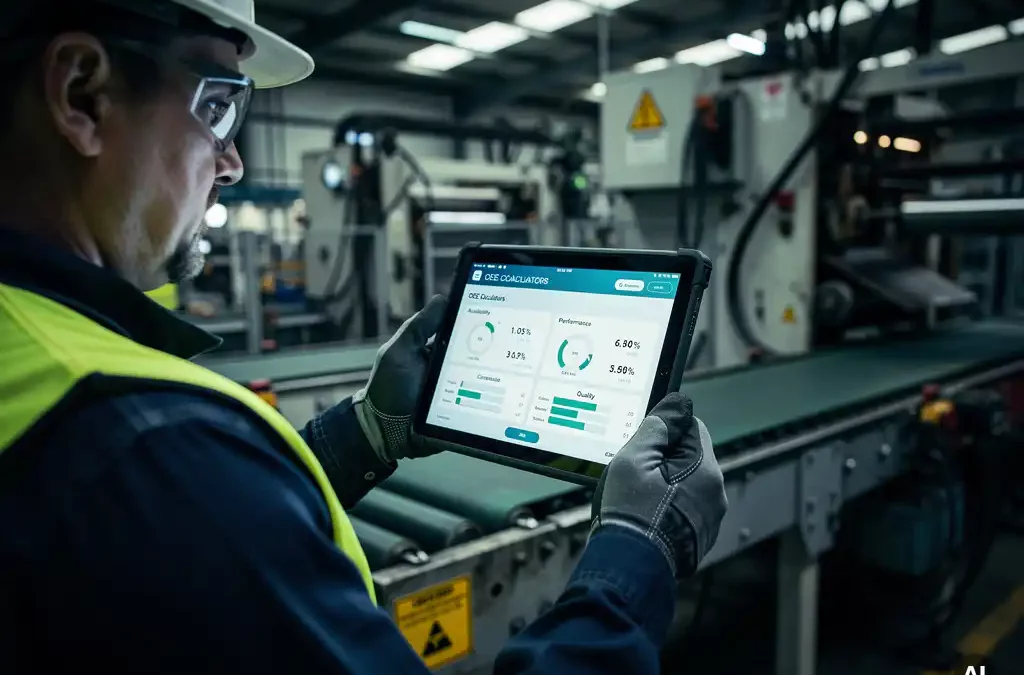
Understanding how to effectively use an OEE calculator on the shop floor can significantly enhance manufacturing performance and efficiency. OEE, or Overall Equipment Effectiveness, is a crucial metric for evaluating the productivity of manufacturing processes. By accurately calculating and interpreting OEE, manufacturers can identify hidden capacity and areas for improvement. This article will guide you through the essentials of OEE, how to calculate it, and practical tips for improving your shop floor efficiency.
Understanding OEE and Its Importance
Overall Equipment Effectiveness (OEE) is a standard for measuring manufacturing productivity. It combines three key elements: Availability, Performance, and Quality. An OEE score of 100% indicates perfect production, which means manufacturing only good parts, as fast as possible, with no downtime.
Understanding OEE is important because it highlights the efficiency of your production processes. Many factories believe they operate at high efficiency, but real-time OEE calculations often reveal a different story. Typically, factories overestimate their uptime, believing it to be between 85 and 90%, while the actual figure is often between 65 and 80%. This discrepancy represents a significant opportunity for improvement.
How to Calculate OEE on the Shop Floor
Calculating OEE involves three components: Availability, Performance, and Quality. Each component is calculated separately and then combined to give the OEE percentage. Availability measures the percentage of scheduled time that the equipment is available to operate. Performance measures the speed at which the equipment operates as a percentage of its designed speed. Quality measures the percentage of good parts produced versus the total parts produced.
To calculate OEE, multiply the three components: OEE = Availability x Performance x Quality. This calculation provides a comprehensive view of where losses are occurring and helps in targeting specific areas for improvement.
Using an OEE Calculator for Real-Time Insights
An OEE calculator provides real-time insights into manufacturing performance. By using a digital tool, you can track OEE continuously rather than relying on end-of-shift reports. This real-time visibility allows for immediate response to issues, significantly reducing downtime.
For example, the Andon Cockpit, a configurable live dashboard, can be set up with custom KPI tiles and trend charts. This setup helps operators and supervisors monitor performance metrics in real time, leading to faster decision-making and improved production efficiency.
Common Challenges in OEE Calculation
One of the main challenges in OEE calculation is data accuracy. Many factories rely on manual data entry, which can lead to inconsistencies and errors. Additionally, calculating OEE at the end of a shift or week can result in overlooked short stops and micro-stoppages.
Another challenge is the lack of granularity. Some factories calculate a single OEE figure for the entire plant, which can mask inefficiencies at the machine or operator level. To overcome these challenges, it's essential to implement real-time data collection and analysis tools that provide detailed insights into each aspect of production.
Integrating OEE Data with Digital Manufacturing Systems
Integrating OEE data with digital manufacturing systems enhances the overall efficiency of production operations. By connecting OEE data with systems like ERP or PLM, manufacturers can achieve a more comprehensive view of their operations and make informed decisions.
Factorise's platform, built on Mendix, offers seamless integration with various manufacturing systems. This integration allows for real-time data flow across different modules, providing a unified view of production performance and enabling continuous improvement.
Practical Tips for Improving OEE
Improving OEE requires a strategic approach focused on reducing downtime, enhancing performance, and improving quality. Start by identifying the biggest loss categories using tools like the Production Loss Pareto, which analyzes losses by category, machine, shift, and period.
Implementing digital work instructions and structured issue logging can also lead to significant improvements. These tools provide operators with clear guidance and help capture issues in real time, facilitating quicker resolutions and reducing production losses.
**Ready to take the first step? We like to start with a fit-gap session: a day or two to understand where you are, which pain points are most urgent, and which modules deliver the fastest value. Book your first fit-gap session. No sales pitch. Just an honest conversation about what's realistic.**
Frequently Asked Questions
What is the ideal OEE score for a manufacturing plant?
An ideal OEE score is 100%, indicating perfect production with no downtime, maximum speed, and no defects. However, a more realistic benchmark for world-class performance is around 85%.
How can I ensure data accuracy in OEE calculations?
To ensure data accuracy, implement automated data collection systems to minimize manual entry errors. Use sensors and IoT devices to capture real-time data directly from machines.
What are some common misconceptions about OEE?
A common misconception is that a high OEE score means there are no areas for improvement. In reality, even high scores can mask inefficiencies if not broken down into availability, performance, and quality components.
How often should OEE be calculated to be effective?
OEE should be calculated continuously in real-time to provide ongoing insights and allow for immediate corrective actions. This approach is more effective than periodic calculations at the end of shifts or weeks.
Can OEE be applied to non-manufacturing industries?
While OEE is primarily used in manufacturing, its principles can be adapted to other industries to measure equipment effectiveness, such as in logistics or service operations.
What tools can help improve OEE on the shop floor?
Tools like digital dashboards, real-time monitoring systems, and automated reporting can help improve OEE by providing visibility into production processes and identifying areas for improvement.
How does OEE relate to lean manufacturing?
OEE complements lean manufacturing by identifying waste and inefficiencies in production processes. It provides a quantitative measure to support continuous improvement initiatives.
Related Articles
- What is Kepware and how does it connect to industrial equipment?
- What does a successful MES implementation look like?
- Why do MES implementations take longer than expected?
- What is the business case for a MES?
- Which manufacturers need a MES?
- What is OPC UA and how does it connect machines to a MES?
- What is the role of data in improving manufacturing performance?
- What is tribal knowledge in manufacturing?
- What is a skill matrix in manufacturing?
- What is the manufacturing skills gap and why is it getting worse?
- What is MTBF and how do you calculate it?
- What is unplanned downtime in manufacturing?
- Does the 85% OEE benchmark apply to every type of factory?
- What is performance in OEE?
- What are the three components of OEE?